Engineering Learning Online

Virtual Ideation Challenge

SUTD (Singapore University of Technology and Design)

Singapore

Singapore

Student cohort

56

Location

100% online

Timing

100% synchronous

Activity type

Extra-curricular

New or existing

New activity

Hands-on element

None

Overview of activity
The student experience
Lessons learnt

Activity overview


The Virtual Ideation Challenge (VIC) was a two-day extracurricular activity where current and incoming SUTD undergraduates connected with clinicians from the regional hospital to tackle key technological challenges facing Singapore’s fight against Covid-19.

Held over a weekend in July 2020, the VIC was a 100% online activity delivered as a partnership between SUTD and a team of clinicians from the Covid-19 response team at Changi General Hospital (CGH). Participating students – taken from across all SUTD disciplines and years groups – were divided into teams, with each tackling one of 14 'case scenarios' devised by the CGH clinicians. The scenarios articulated 14 key challenges by faced across the three major phases of the clinical and public health response to Covid-19 in Singapore: pre-pandemic (preparations for a pandemic); ongoing pandemic response (the pandemic response) and post-pandemic (the 'new normal').

The opening sessions exposed students to the context for the VIC, with webinars from CGH clinicians, as well as videos and 360 degree interactive photographs from CGH wards and local foreign workers dormitories, which saw rapid transition of Covid-19 during the early weeks of the pandemic. From there, the Challenge took a highly structured approach to guide students through the ideation process step-by-step over the two days. Online support and facilitation for the student teams was provided by group of graduate mentors and 21 CGH clinician mentors. At the close of the two days, teams presented their ideas and ideation process to a judging panel via a 5-minute online pitch.

Distinctive features:


Two distinctive features set the Virtual Ideation Challenge apart from other case studies:
  • the activity was designed and delivered in close collaboration with clinicians at the regional hospital (CGH) and gave students a unique immersion in a real-life public health challenge;
  • participation was open to future incoming SUTD students (who had yet to matriculate) as well as all current SUTD undergraduates.

Reflections and lessons learnt


The review of the Virtual Ideation Challenge drew upon one-to-one interviews with 10 individuals: two university leaders in teaching and learning; the two co-leads of the activity from SUTD; two clinician mentors from CGH (one of which was the activity coordinator from CGH); the coordinator of the graduate mentors; and three student participants.

Taking interviewees' experiences and perspectives together, outlined below are the key success factors, challenges faced and advantages of the online delivery of the Virtual Ideation Challenge.

Success factors

Interviewee feedback and reflections pointed to four factors that underpinned the success of the Virtual Ideation Challenge:

  • 'virtual immersion' in the challenge context: student participants were offered a unique access to the national Covid-19 environment, from both public health and clinical perspective, with exposure to the ‘front line’ of Singapore’s response in both the hospital wards and foreign workers dormitories. This immersion in the clinical context, together with targeted support offered by the clinical mentors, was pivotal to the students’ progression in this time-limited activity and supported the development of insightful and innovative solutions. Interview feedback made clear that this access and mentorship also underpinned high levels of student engagement and focus, despite many working with previously unknown team-mates in an online environment.

  • on-demand, flexible support offered to participants: participants spent the majority of the two-day challenge working in Zoom break-out rooms with their team. Given that more than half of participants had yet to start their formal studies at SUTD, a lack of clarity on both the design process and the challenge deliverables presented a real risk for teams in this time-limited activity. However, interview feedback suggested that the on-demand facilitation offered by the graduate mentors allowed teams to call for support as and when needed. Facilitators offered both practical support, but helped students to consider the types of mindset and approach that might help them to tackle the challenge.

  • close working relationship between SUTD and the regional hospital (CGH): the Virtual Ideation builds on an established and close working relationship between SUTD and CGH, which has already seen the development of a new undergraduate healthcare and engineering track. The trust built through this relationship, as well as a pre-existing understanding of constraints and opportunities offered by each partner, appears to have been pivotal to the rapid development of this activity and its ability to secure so many clinical mentors.

  • significant levels of pre-planning: the Virtual Ideation Challenge was devised and designed in a very short time period: in the three period prior to it launch. Despite this rapid turn-around, significantly levels of time had been dedicated to planning and preparation for the activity. For example, in addition to training of the graduate mentors, rehearsals were held with clinician mentors and activity judges to identify and resolve any technical issues and ensure that all contributors understood the challenge context, the scoring rubrics, and the structure of the two days. The organisers also prepared back-up versions of all presentations, in case of network problems and even located organising committee members in different parts in Singapore to mediate the risk of internet connectivity issues in a localised area.

Challenges faced

Interviewee feedback pointed to two key challenges faced in the delivery of the activity; plans are in place to tackle each of these issues in any future iterations of the activity:

  • lack of breaks in the two-day schedule: although the activity scheduled two half hour breaks for lunch each day, in reality, team-working and mentoring sessions expanded out to fill the two days. Unsure of when mentors or event organisers might check-in on teams, students were often left unsure when they were able to takes breaks from their screen. As a result, most teams continued to be logged on throughout both days, without taking formal breaks, leaving many very tired at the close of the activity. For future iterations of the activity, organisers plan to embed mechanisms by which teams are able to take structured breaks from working without penalty to their access to mentoring support.

  • omission of hands-on, prototyping opportunities: hands-on learning and prototyping are core features of the SUTD education, features which are highly valued by current and prospective students alike. It is therefore perhaps not surprising that participants pointed to the lack of a prototyping element as a major constraint of the Virtual Ideation Challenge. While embedding a hands-on element was understood not to feasible for the 2020 activity, particularly given the three-week development window available before launch, plans are in place to support prototype development for future iterations of the activity.

Advantages of online delivery

Interviewee feedback suggested that the online nature of the Virtual Ideation offered a number of important advantages to the activity organisation and student learning, beyond what might have been possible it the activity was held face-to-face.

The key benefit was the ability to secure a group of 21 clinicians – each of whom was engaged in the testing, prevention and treatment of Covid-19 in Singapore – to play an active role in this synchronous activity, through offering information, support and mentorship to the student participants. As many interviewees notes, it would not have been possible to secure the time of this group if they had been required to travel to the SUTD campus to make these contributions. With clinicians connecting remotely from home, work or while travelling, the online nature of the activity facilitated such real-time connection.

Interviewees also pointed to a number of other benefits of the activity's online delivery. For example, the ways in which teams were able to connect with design mentors – through the messaging app Telegram – allowed them to benefit from targeted support as and when it was needed, with mentors able to join the team almost immediately after they requested help. Some also noted that the online nature of the activity supported ongoing sharing of learning between teams, with students benefitting from accessing the questions posed by peer teams through the messaging app and learning from the responses given by mentors and organisers.

Structure of the two days


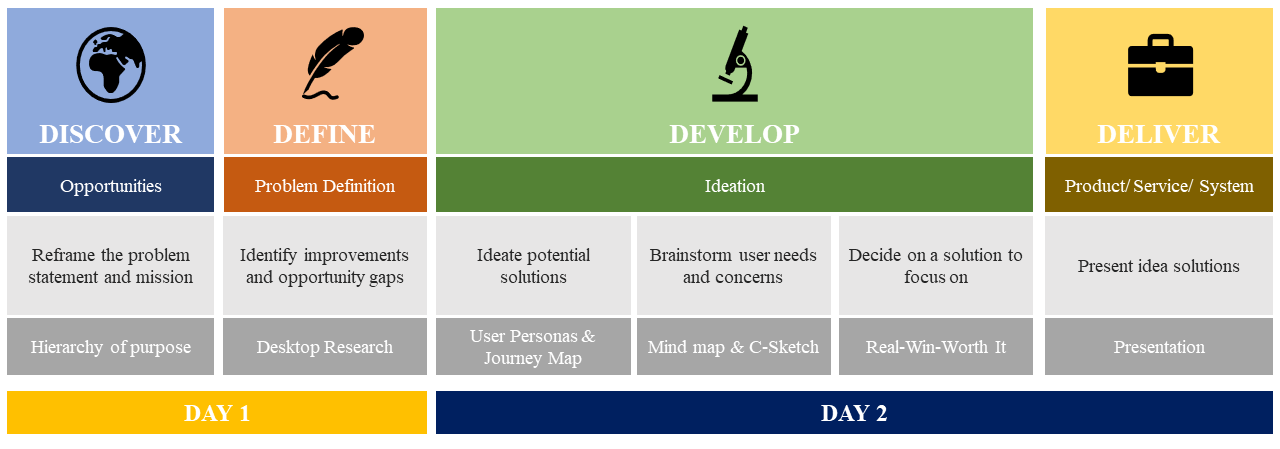
Structured around the '4D' (or 'Double Diamond') design process, the two day activity is divided evenly across the four stages of Discover, Define, Develop and Deliver:

1. Discover

The opening session, on the Saturday morning, exposed students to the environment and challenges at the front-line of Singapore's response to Covid-19 to set the stage for the Challenge. Activities included: a panel from CGH provided perspectives from by the hospital and public health perspectives; videos highlighting particular challenges in hospital wards, testing programs and in worker dormitories; an interactive virtual tour of the wards and workers dormitories. Students were also given a 40 minute 'crash course' in design methods and the ideation process, which was particularly targeted at the 'future' SUTD students , who had not yet experiences the SUTD approach to design. At the end of the session, students were introduced to the 14 different 'case scenarios', each articulating a key challenge facing Singapore's pandemic response.

2. Define

During the second session, on the Saturday afternoon, teams select their preferred challenge (allocated on a first-come-first-served basis) from the 14 'case scenarios' given. Teams then reframe the problem statement for their challenge, identify existing solutions and define their team mission. As well as on-demand facilitation from graduate mentors, clinical mentors also connected with the teams to provide further information and answer any questions they may have about their challenge context.

3. Develop

The third session, on the Sunday morning, teams used user personas and journey maps to explore the challenge from a user perspective and develop a range of possible solutions. Teams then selected and developed their preferred solution, which they were able to discuss with their clinical mentors.

4. Deliver

In the final session, on the Sunday afternoon, teams developed and delivered a five-minute pitch of their challenge, design process and idea. The pitch was delivered to a panel of judges which included the chairman of medical board of CGH, SUTD leadership and the director of the SUTD entrepreneurship centre. As each team tacked a different case scenario, the final session exposed participating students to 14 different challenges and solutions across all three pandemic phases: pre-pandemic, ongoing pandemic and post-pandemic. Similar to the opening 'discover' session, attendance at these presentations was open to the whole SUTD and CHG communities.

Stacks Image 280875

Challenge


Teams were asked to select one 'case scenario' and associated problem statement from 14 options presented by CGH clinicians around the theme: "Re-imagining healthcare in the time of Covid-19". Case scenarios were allocated to teams on a first-come-first served basis, such that all challenges were being tackled by one team. The 14 case scenarios posed by the clinicians spanned the three key stages of a disaster response cycle:

Pre-pandemic

Five 'case scenarios' were taken from the pre-pandemic stage, which focused on mitigation and preparedness.

Case scenario: International surveillance of emerging infectious diseases is an important component of public health function. There is growing evidence that a new virus is showing regional spread in one part of the globe. The impact on Singapore needs further clarity.

Problem statement: How might we use technology to monitor and assess the significance of potential infectious disease outbreaks in other countries?

Example of case scenario from pre-pandemic stage

Ongoing pandemic

Five 'case scenarios' were taken from the current pandemic stage, which focused on the response.

Case scenario: Many patients have presented to public hospitals with fever, coughing and acute respiratory distress. Their chest X-rays and CT scans show lung changes typical of COVID pneumonia. Within a few days, ICUs are swamped with patients who are deteriorating and require endotracheal intubation for mechanical ventilation. The national stockpile of ventilators is inadequate to meet this surge in demand. Hard choices have to be made.

Problem statement: How might we design a triaging tool to select which patients to intubate and ventilate, and who not to? How might we convince clinicians that tool can make better “life and death” decisions than them?

Example of case scenario from ongoing pandemic stage

Post-pandemic

Four 'case scenarios' were taken for the post-pandemic stage, which focused on the recovery and the 'new normal'.

Case scenario: The development of vaccines seems to be a constant catch-up game where respiratory viruses e.g. influenza virus, coronavirus, are concerned. This is mostly due to the rapid mutation rate of such viruses.

Problem statement: How might we pre-emptively design a “perfect” vaccine even before a disease outbreak begins, while ensuring that the vaccine is affordable by most countries? (After all, until all of us are safe, none of us are safe.)

Example of case scenario from post-pandemic stage

Deliverables


The final deliverable – presented by student teams at the close of the two days – was a five minute online pitch which outlined the team's case scenario, their design process, their idea/solution and the team's future plans. Four judging criteria were adopted for these presentations:

  • Solution fit: does the proposed solution address the problem and user needs effectively?
  • Innovation: does the solution present a creative and original approach to solving the problem, that is also feasible and implementable?
  • Design-thinking: how well has the team used the design-thinking framework (discover, define, develop, deliver) to inform their solution?
  • Presentation: how well is the team able to articulate their proposal and engage the audience?

In addition, teams were asked to prepare a short report, which brought together the five interim deliverables that teams submitted over the course of the two days:

  1. refined problem statement;
  2. team mission;
  3. existing solutions to the problem statement;
  4. user personas;
  5. user journey map.

The Challenge was extra-curricular and non-credit-bearing for the students' undergraduate studies.

Teaching team


The team engaged in the development and delivery of the Virtual Ideation Challenge included:

  • 2 course leads from SUTD and 2 clinical leads from CGH
  • 21 clinical mentors from the Covid-19 response team at CGH
  • 5 graduate mentors from SUTD, including one coordinator
  • webinar speakers, judging panel, and organising committee, including leaders, innovators and clinicians from both SUTD and CGH

Graduate mentors had all participated in SUTD's Innovation By Design courses, and had all attended a training session prior to the VIC. Based on this briefing, the two major areas of focus for the graduate mentors when engaging with the teams was:

  1. students' mindset: ensuring that teams understand what is expected of them throughout the VIC, and (in particular) that they are punctual and play an active and positive role in their team's activities;
  2. team progress: ensuring that teams are clear about the goals and deliverables for the VIC and keep on track throughout the two days.

Graduate mentors were provided with a written briefing – the 'Facilitator's Toolbox' – which outlined the key priorities for facilitation, the detailed schedule for the two days, and the key team deliverables.

Participants


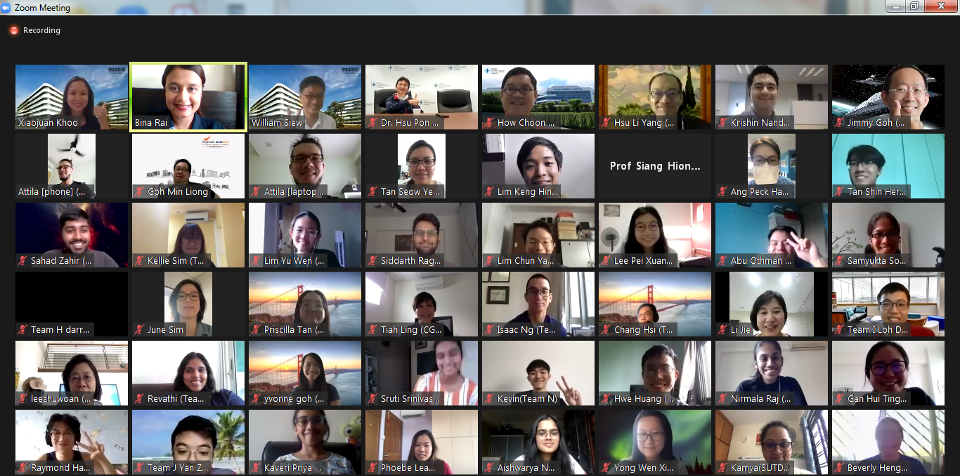
Around half of the 56 participants were 'future' SUTD students, due to start their undergraduate studies in September 2020. Students were given the option to form their own teams. The remaining participants were allocated to teams based a pre-activity survey of students' prior experience with the design process and their personality profile. It was required that all teams must contain at least one current student (who therefore had participated in SUTD's "Introduction to Design" course and had prior experience of undertaking design projects).

Stacks Image 281461

Technology used


The following applications and technologies were used in the delivery of the four key phases of the Virtual Ideation Challenge:

1. Discover

  • Zoom was used for the webinar sessions, with student participants hidden from view except during the Q&A sessions, where they were able to ask questions using the 'chat' function;
  • 360 degree immersive cameras were used to allow students to explore the environment at the CGH emergency room and at workers dormitories.

2. Define & 3. Develop

  • Zoom breakout rooms were provided for each student team;
  • all students were invited to join a private channel of the messaging platform Telegram, which allowed teams to ask questions or seek help from mentors or activity organisers in real time. Telegram was also used to Issue instant messaging reminders to the teams about various project deadlines;
  • Google Folders were used as a design toolkit for student teams, with information on the activity schedule, deadlines and templates for each of the challenge deliverables.

4. Deliver

  • Zoom webinars for the team presentations;
  • Google Folders tor the submission of final reports from each team.

Downloads


3-page schedule for the two days

Institutional context


R. H. Graham Consulting Limited, Company Number: 08808504